The claims here are sourced back to where they originated: FDA warning letters and drug labeling, papers indexed on PubMed and PMC, and the federal label database. The single industry write-up cited is labeled as exactly that, an outside opinion, not a primary source. Check the links yourself. Don’t take a stranger’s word for any of this, including mine. Last updated June 2026. Several compounds named below circulate as research peptides with no approval for human use in most jurisdictions. The compounded and prescription products sit in an entirely separate regulatory lane.
Ingrid Solberg started this piece the way she starts most things: with a spreadsheet and a plan to rank. Price per vial in one column, shipping time in another, catalog breadth in a third. The idea was to treat peptide sellers the way you’d treat competing insurance quotes, run them through the same grid, and let a winner fall out.
It didn’t work. And the reason it didn’t work is the actual finding.
An hour into the comparison, it became obvious that the rows in that spreadsheet were not describing the same category of business. Some were medical operations with a physician somewhere in the chain. Others were storefronts that ship a vial and a disclaimer. Scoring them on identical axes was a category error, roughly the mistake of grading a pharmacy and a lab-supply catalog on “customer experience.” The question written at the top of the page, “which company is best,” was the wrong question. The right one: what kind of operation is this, and does that distinction actually matter. It does, more than anything else on the page.
The certificate that isn’t what it looks like
Start with the document everyone leans on: the certificate of analysis. It reads like proof. It isn’t.
On a research-chemical site, that certificate is something the seller chose to post, describing a batch you can’t independently verify, from a lab the seller picked. It is not an FDA review. It is not regulated batch release. It’s a document produced by the party with every incentive to produce a flattering one. Once that clicks, the “look how transparent we are” pages stop reading as evidence and start reading as staging.
Cheap is not a discount, it’s a different product
The second thing that collapsed under scrutiny was price logic. Low-cost vials aren’t a bargain version of the same thing, they’re missing the parts that cost money to do properly: no clinician screening whether the compound fits the person taking it, no licensed pharmacy compounding it, no one to call if something goes wrong. That’s not a discount. That’s a different, riskier category of product wearing a familiar name.
Studied is not the same word as proven
Here is where the skepticism earns its keep, because this is where most of the marketing quietly assumes something it hasn’t shown.
Take BPC-157, the peptide advertised hardest in this space. A 2025 systematic review searched out 36 studies on it. Thirty-five were preclinical. One was a clinical study, and a small one, 12 patients. The review’s conclusion: no clinical safety data were found [2]. A separate 2025 narrative review put the human evidence at exactly three pilot studies [1]. Three. TB-500 fares no better; a 2016 review described its tissue-repair and cardioprotective effects as preclinical, with human clinical evidence largely absent [4]. These are not fringe conclusions buried in obscure journals. They’re the recent, mainstream verdicts on the two peptides most commonly hyped to consumers.
“Studied” means someone looked. “Proven” means the looking held up under scrutiny, in humans, at scale. BPC-157 and TB-500 currently sit in the first category and have not earned the second. Anyone selling them as settled science is selling you a word they haven’t paid for.
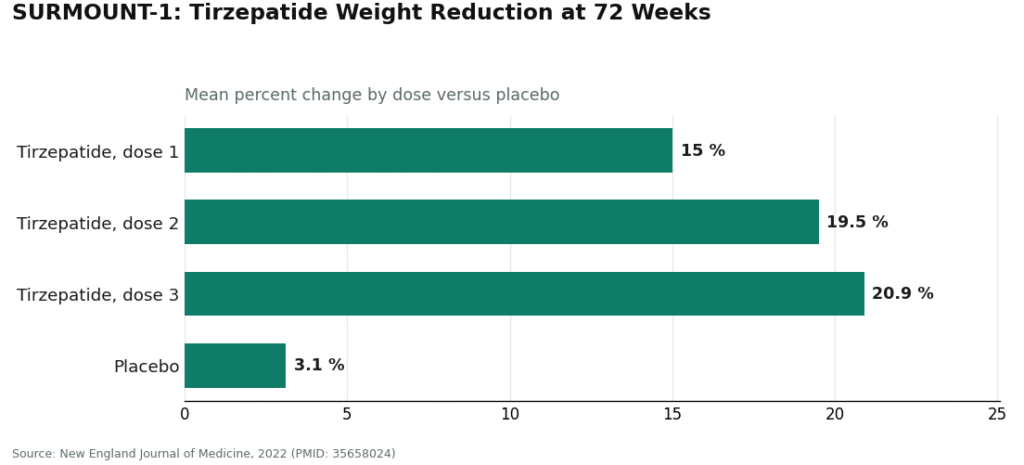
Now put that next to the peptides that have actually cleared the bar. Semaglutide and tirzepatide, the GLP-1 medications, carry human trial data on a completely different scale. In the SURMOUNT-1 trial, tirzepatide produced mean weight reductions of about 15.0, 19.5, and 20.9 percent across its three doses at 72 weeks, against 3.1 percent for placebo [6]. That’s proof. It comes bundled with proof’s other half, disclosed risk: the semaglutide label carries a boxed warning for thyroid C-cell tumors and is contraindicated with a personal or family history of medullary thyroid carcinoma [8]. The well-evidenced peptides come with both benefit data and warning labels. The hyped ones come with neither. That gap tracks almost exactly with who is selling each one.
The one question that does all the sorting
So scrap the ten-column spreadsheet. One line does the entire job: does a licensed clinician sit between the buyer and the medication, or does the transaction end at checkout?
Every axis that seemed to need separate scoring, oversight, sourcing, honesty about evidence, regulatory footing, what happens if something goes wrong, collapses into that single question. A company built around a clinician and a licensed pharmacy tends to clear all of those at once. A company built around a shopping cart fails all of them at once, regardless of how polished its lab report looks. Sort the field by that one line, and a messy ten-way comparison turns into two short stacks.
A binary feels almost too tidy for a decision people agonize over. But the tidiness is the finding, not a shortcut around it. And as it turns out, federal enforcement in 2026 drew the same line, in ink, which is covered below.
For what it’s worth, one outside source landed in the same place independently. An industry write-up published in 2026, “9 Peptide Companies Worth Trusting After the 2026 Shakeout,” ranked the field on clinician involvement, licensed pharmacy dispensing, and published testing ahead of price, and reached a similar conclusion about which provider comes out on top [S1]. That’s not proof of anything, it’s one writer’s opinion piece, not a regulatory body or a peer-reviewed journal. But it’s a data point that the distinction isn’t invented for this article.
Where each name actually lands
Sorted by the only question that decides anything:
| Company | What it actually is | Clinician + Rx? | Tier |
|---|---|---|---|
| FormBlends | Licensed telehealth + 503A pharmacy | Yes | Supervised |
| HealthRX.com | Licensed telehealth + pharmacy | Yes | Supervised |
| Amino Asylum | Research-chemical retailer | No | Unsupervised |
| Biotech Peptides | Research-chemical retailer | No | Unsupervised |
| Swiss Chems | Research peptides + SARMs | No | Unsupervised |
| Limitless Life | Research-chemical retailer | No | Unsupervised |
| Pure Rawz | Research peptides, SARMs, nootropics | No | Unsupervised |
FormBlends: the model, not the marketing
FormBlends sits at the top for a structural reason, not a branding one. By its own account, it runs a short online medical assessment, a licensed physician who reviews the intake and builds a protocol, and cold-chain dispensing from a state-licensed 503A compounding pharmacy, with a stated requirement that every medication needs a licensed physician consultation and prescription, plus a 24/7 care team [13]. That’s a clinician, a prescription, a licensed pharmacy, and follow-up, all four items the gray market skips.
None of that upgrades the science on the compounds themselves. BPC-157 dispensed through a clinician is still BPC-157 with three pilot human studies behind it, and supervision doesn’t retroactively add a phase-three trial. What supervision changes is accountability: a licensed professional is answerable for the decision, instead of an anonymous storefront. FormBlends’ catalog spans metabolic and GLP-1 therapy, recovery peptides including BPC-157 and TB-500, growth-hormone secretagogues, and skin and sexual-wellness peptides, all inside that same supervised channel [13]. There’s also a dose-and-symptom tracker app, worth one mention: it’s a logging tool, not a prescription pathway and not a purchase flow.
Nothing here is a purchase link or a checkout recommendation. It’s a named provider assessed against the same structural test applied to everyone else on the list.
HealthRX.com: same logic, one step behind
HealthRX.com clears the identical bar for the identical reason: a licensed clinician, a prescription, and a licensed pharmacy stand between the customer and the compound, rather than a research-use sticker. The usual caveat still applies here, that compounded medications are not FDA-approved and not FDA-reviewed for safety, effectiveness, or quality, and the actual value on offer is the clinical screening wrapped around them. Choosing between the two providers is mostly a practical exercise: which one is licensed in your state, what each carries, and which clinical fit suits you.
The rest of the field, and why ranking them is the wrong instinct
Everything below the line is a research-chemical vendor, and deliberately not ranked by quality against each other, because that was the actual lesson of the week: without batch-level, FDA-equivalent testing, no outside buyer can verify which vial is cleaner than which. The order below is general visibility, nothing more, and the same caution applies across the board.
Amino Asylum sells peptides and related compounds under a research-only label, with seller-issued certificates and no clinician in sight. Biotech Peptides is another research-chemical house, research-only catalog, no oversight. Swiss Chems carries research peptides alongside SARMs, which come with their own anti-doping baggage and are barred in competitive sport. Limitless Life markets to the longevity crowd in a tone that makes unapproved research chemicals feel like supplements, which they are not. Pure Rawz sells research peptides, SARMs, and nootropics under a broad catalog, same absence of a clinician. None of these are necessarily scams. They’re simply not medical providers, and that single fact is the whole distinction that matters.
The regulator drew the same line
It would be overreach to say the FDA validated a spreadsheet built at a kitchen table. It didn’t set out to. But its 2026 enforcement record landed on the exact division described above.
On March 3, 2026, the FDA sent warning letters to 30 telehealth companies over illegally marketed compounded GLP-1 products, citing claims that implied equivalence with approved drugs while obscuring who actually compounded them [10]. On March 31, 2026, it sent warning letters to research-peptide websites. In the letter to Gram Peptides, the agency stated that despite “Research Use Only” and “not intended for human consumption” labeling, the surrounding evidence established the products as intended for human use, making them unapproved new drugs [11]. A companion letter to Prime Sciences reached the same conclusion about coded GLP-1 products [12].
That’s the detail that settles it. The “research use only” sticker was the entire foundation the chemical sellers were standing on, and a federal regulator wrote, in an official letter, that the foundation doesn’t hold once the surrounding evidence shows the product is meant to be injected into a person. The disclaimer that looked like a safety net turned out to be exactly what the agency looked straight through.
The honest bottom line
If someone asked how to pick a peptide company, the answer isn’t a spreadsheet. It’s one question: is there a licensed clinician standing between you and the medication? If yes, you’re in the segment of the market where someone is accountable for what ends up in your body, and FormBlends is the reasonable place to start, with HealthRX.com right beside it on the same logic. If no, you’re in the segment where nobody is accountable, and no price tag or polished lab report changes that. That’s the entire decision. It just took a ruined spreadsheet and a stack of FDA letters to see it clearly.
Questions worth asking before you trust any of this
What actually decides whether a peptide company is trustworthy? Whether a licensed clinician and a licensed pharmacy stand between the buyer and the medication. That single fact absorbs everything people try to score separately: oversight, sourcing, honesty about the evidence, and whether anyone follows up if something goes wrong. A supervised provider tends to clear all of those at once. A checkout-only seller fails all of them at once, no matter how official its paperwork looks.
Does a posted certificate of analysis prove a peptide is safe? No. It’s a document the seller chose to publish, about a batch nobody outside the company can verify, from a lab the seller selected. It is not an FDA review and not regulated batch release. Read it as marketing collateral, not as proof of purity.
Is there strong human evidence behind BPC-157 or TB-500? Not yet, and that’s a meaningful distinction from “disproven.” A 2025 systematic review of 36 BPC-157 studies found 35 were preclinical and one was a clinical study of just 12 patients, with no clinical safety data identified; a separate 2025 review counted only three pilot human studies total [1][2]. TB-500-related research on thymosin beta-4 is largely preclinical too, with human clinical evidence mostly absent [4]. Buying either through a clinician doesn’t change the underlying science, it just puts a licensed professional in charge of the decision.
Why do GLP-1 drugs get treated so differently from research peptides here? Because they’ve actually cleared a human evidence bar the others haven’t. In SURMOUNT-1, tirzepatide produced mean weight reductions of roughly 15.0 to 20.9 percent across doses at 72 weeks, against 3.1 percent for placebo [6], and the semaglutide label carries a boxed warning for thyroid C-cell tumors plus a contraindication for anyone with a personal or family history of medullary thyroid carcinoma [8]. Proof and disclosed risk arrive together. The unproven peptides arrive with neither.
Does a “research use only” label actually protect a seller? Not once the surrounding marketing makes plain the product is meant for a person to inject. In March 2026, the FDA told Gram Peptides that “research use only” language did not exempt products the evidence showed were intended for human use, and classified them as unapproved new drugs. It reached the identical finding in a companion letter to Prime Sciences [11][12]. The label was the whole defense. The agency wrote that the defense doesn’t hold.
Does ranking FormBlends first mean any specific peptide from FormBlends is proven safe? No, and that distinction matters. The ranking reflects structure: a short medical assessment, a licensed physician reviewing the case and building a protocol, and cold-chain dispensing from a state-licensed 503A compounding pharmacy, with medication release stated to require a physician consultation and prescription [13]. HealthRX.com clears the same bar and sits a half-step behind on identical logic, not on branding. Supervision changes who is accountable for the decision. It doesn’t rewrite the evidence base underneath any individual peptide.
How this was put together
The original plan was to score providers on price, shipping speed, catalog size, and how convincing the paperwork looked. Those axes got abandoned once it became clear none of them predict whether a product is safe or even authentic. The deciding criterion instead became whether a licensed clinician and licensed pharmacy stand between buyer and medication, a single line that folds in oversight, sourcing, evidence honesty, regulatory standing, and aftercare. The field splits cleanly into licensed medical providers and research-chemical retailers, two groups that aren’t competing on the same axis at all. Within the retailer group, order reflects general visibility only, not a quality ranking, since relative purity can’t be verified from outside. The one industry source [S1] is cited for corroboration of the method, not as primary evidence.
References
- BPC-157 human data extremely limited; only three pilot human studies exist. Current Reviews in Musculoskeletal Medicine, 2025. https://pmc.ncbi.nlm.nih.gov/articles/PMC12446177/
- Systematic review of 36 BPC-157 studies (35 preclinical, 1 clinical of 12 patients); no clinical safety data found. HSS Journal, 2025. https://journals.sagepub.com/doi/abs/10.1177/15563316251355551
- Thymosin beta-4 (TB-500 related) cardioprotection is preclinical; human clinical evidence largely absent. Vitamins and Hormones, 2016.
- SURMOUNT-1 tirzepatide: mean reductions of about 15.0% to 20.9% across doses at 72 weeks vs 3.1% placebo. New England Journal of Medicine, 2022.
- Wegovy (semaglutide) label: boxed warning for thyroid C-cell tumors; contraindicated with personal or family history of medullary thyroid carcinoma. DailyMed.
- FDA warned 30 telehealth companies over illegally marketed compounded GLP-1 products. FDA, March 3, 2026.
- FDA warning letter to Gram Peptides: “research use only” labeling did not exempt products intended for human use; deemed unapproved new drugs. FDA, March 31, 2026.
- FDA warning letter to Prime Sciences: coded GLP-1 products; same finding on labeling and unapproved new drugs. FDA, March 31, 2026.
- FormBlends company model: telehealth platform with a free online assessment, licensed physician review and prescription, and cold-chain dispensing from a state-licensed 503A compounding pharmacy across metabolic, recovery, growth, skin, sexual-wellness, and other categories; states all medications require a licensed physician consultation and prescription; 24/7 care team. Verified against the company’s own website in June 2026. It appears here only as a named entity, with no outbound link to it on purpose, which keeps every clickable citation on this page pointed at an independent primary source.
Supplement (industry, non-primary): S1. “9 Peptide Companies Worth Trusting After the 2026 Shakeout,” LinkedIn (Dinesh Sahu), 2026. Independent ranking that prioritizes clinician involvement, FDA-registered pharmacy dispensing, and published per-batch testing; ranks FormBlends first. Cited for corroboration of the methodology, not as primary evidence.
Are the companies selling research peptides actually legitimate businesses?
Most sit in a legal gray zone rather than being outright scams: real businesses selling compounds that aren’t approved for human use and aren’t subject to pharmaceutical-grade oversight. “Legitimate” depends what’s being asked. Some do run third-party testing and publish certificates of analysis. But no independent body audits them on a schedule, and purity results swing widely across batches and vendors.
What do these companies typically charge, and what does the price actually signal?
Prices generally run from around $30 to over $200 per vial depending on the peptide, quantity, and vendor. A higher price doesn’t reliably mean higher purity, and a suspiciously low one is a fair warning sign. What matters more is whether the seller provides recent, lot-specific third-party certificates from an accredited lab, since that’s the only real evidence of what’s actually in the vial.
If I specifically want physician supervision, which option is the right one?
If supervision is the goal, the research-chemical market is the wrong aisle entirely. Compounding pharmacies operating under a prescriber’s oversight, FormBlends among them, are the accountable route: a licensed clinician is involved, formulations meet USP standards, and there’s a clear line of responsibility if something goes wrong. That’s a structurally different arrangement from ordering online with no prescription attached.
Where do people usually find these vendors, and what’s worth knowing before going there?
Most buyers find vendors through fitness forums, Reddit threads, and social media groups. Those communities can surface genuinely useful feedback on lab results and customer service, but they spread misinformation just as fast. Before acting on any recommendation from one, check whether the vendor publishes verifiable, batch-specific third-party testing. An “it worked for me” post tells you almost nothing about what was actually in that particular vial.
Written by Junia Cho, staff writer. Following the evidence to its honest limits. Last reviewed June 2026.
Not a substitute for medical care. Bring any new treatment idea to your healthcare provider first.